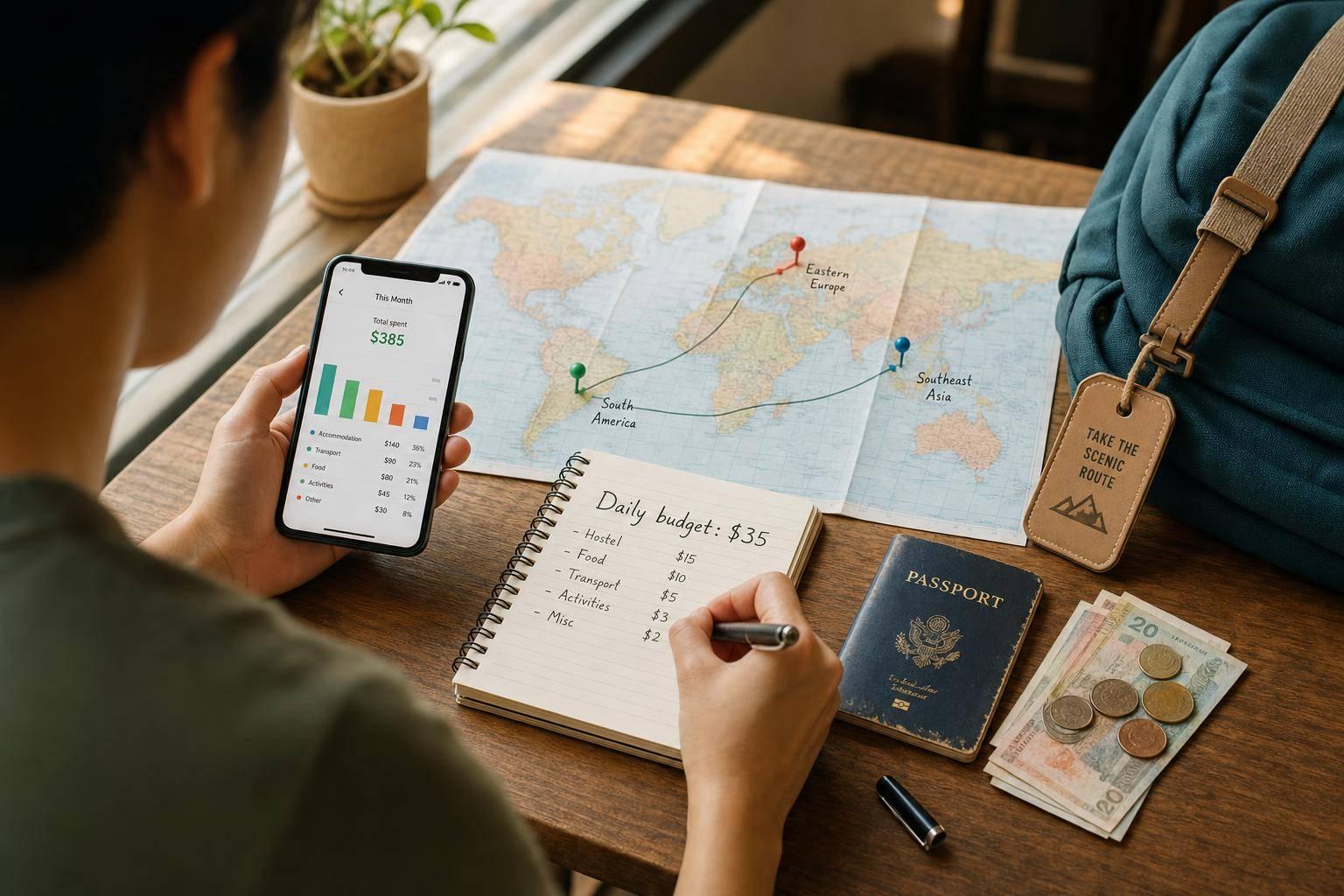
You do not need a huge bank account to travel long-term. A budget trip can start around $20,000 per person for a year, and in lower-cost places, some travelers get by on about $50 a day.
Here’s the short version: I’d keep costs down by going to cheaper regions, moving slower, booking flights with flexible dates, and tracking every dollar before and during the trip. The biggest money drains are usually flights, lodging, fast-moving routes, food, local transit, fees, and small daily purchases.
If I wanted a simple plan, I’d focus on these points first:
- Build the full budget before booking
- Add a 15% buffer for surprise costs
- Set a daily spending limit
- Use cheaper regions like Southeast Asia, Latin America, or Eastern Europe
- Stay longer in each place to cut lodging and transport costs
- Cook some meals and use public transit
- Avoid bank, ATM, and currency conversion fees
- Track spending in Monefy by category and currency
- Keep a separate emergency fund of at least $500 to $1,000, or more for long trips
A few numbers make the point fast: Western Europe can run about $80 to $130 a day, while Southeast Asia is often closer to $25 to $50 a day. Stay put longer, and monthly costs can drop hard because transport falls and lodging discounts kick in.
Quick Comparison
| Cost Area | Lower-Cost Approach | Higher-Cost Approach |
|---|---|---|
| Region | Southeast Asia, Latin America, Eastern Europe | Western Europe, Japan, Australia |
| Travel Pace | Stay 2 to 4 weeks or longer | Move every 2 to 3 days |
| Flights | Mid-week, flexible dates, nearby airports | Fixed dates, peak season, last-minute |
| Lodging | Hostels, guesthouses, kitchens, weekly rates | Hotels, tourist zones, short stays |
| Food | Lunch specials, groceries, street food | Most meals in tourist restaurants |
| Local Transit | Walking, biking, transit passes | Taxis and ride-hailing |
| Money Use | Fee-free cards, local currency, fewer ATM withdrawals | Foreign transaction fees, airport exchange, frequent withdrawals |
| Budget Control | Daily tracking in Monefy | No tracking until money runs low |
So if I were cutting this guide down to one idea, it would be this: pick cheaper places, slow the trip down, and track spending every day. That’s how I’d give a travel budget a much better shot at lasting.
sbb-itb-02fd20a
Build a Travel Budget Before You Book Anything
Estimate Your Total Trip Cost in USD
Do the full trip math before you book a single flight or hotel. It sounds a little boring, sure, but this step can save you from running out of money halfway through your trip.
Use this formula to set your total trip budget: (Flights + Accommodation + Daily Spending × Trip Length) + 15% buffer = Total Trip Budget.
That extra 15% matters more than people think. It gives you room for airport transfers, baggage fees, and those annoying surprise costs like medicine or a pharmacy stop.
Daily spending in Southeast Asia is often $25–$50, while Western Europe can run $80–$130 per day. Here’s how that looks across common trip lengths:
| Trip Length | Southeast Asia | Eastern Europe | Western Europe |
|---|---|---|---|
| 3 Months | $2,700 – $4,320 | $4,050 – $6,750 | $7,200 – $10,350 |
| 6 Months | $5,400 – $8,640 | $8,100 – $13,500 | $14,400 – $20,700 |
| 12 Months | $10,800 – $17,280 | $16,200 – $27,000 | $28,800 – $41,400 |
Estimates exclude international flights, visas, and insurance.
You’ll also want to budget for the stuff outside your day-to-day spending: international flights, visas ($50–$120 each), travel insurance (about $2–$15/day), vaccinations, and gear. Prices can shift a lot by country, so check local costs before you decide how much to save.
Use Monefy to Free Up Money for Your Travel Fund

If you want to build a travel fund fast, start with your current spending. Open Monefy, review the last three months, and look hard at the money that slips away on things like restaurant meals, subscriptions, and rideshares.
Even a 30% cut in those categories can add up fast.
A simple approach works well here:
- Review your spending in Monefy
- Cut one discretionary category
- Move that exact dollar amount into your travel fund
- Track that transfer in Monefy
That kind of one-for-one move keeps the process simple. You spend less here, and that same money goes there.
Monefy’s customizable reminders and syncing can help you stay on track. Its multi-currency support also makes life easier when you’re abroad, since you can log purchases in local currency and still watch your running total in USD.
Set a Daily Budget You Can Stick To
A trip budget only works if your daily spending has some guardrails. Break your spending into five buckets: accommodation, food, local transportation, activities, and a small miscellaneous cushion.
A good starting point is the 1/3 split: lodging and transport, food and activities, and a buffer. It’s not perfect for every trip, but it gives you a clean baseline.
Set up matching categories in Monefy so you can track spending in local currency while still seeing what it does to your full USD fund. That matters because currency conversion fees can quietly eat up 3%–6% of your budget.
Early-trip overspending is common too. Most travelers overspend by nearly 25% in the first few days of a trip. That’s the classic “I just got here, let’s do everything” problem. A clear daily limit in the app makes it easier to spot that drift before it snowballs.
Keep a separate emergency fund of $500–$1,000 USD that you do not use for daily spending. Track it in Monefy as its own off-limits category. That way, one rough day doesn’t wreck the rest of your budget.
Once your daily limit is set, the next move is to trim the biggest costs left: flights, stays, and route length.
Cut the Three Biggest Costs: Flights, Lodging, and Route Planning
With your daily budget set, trim the biggest upfront costs next: flights, lodging, and route planning. Those three shape most of what you’ll spend, so it makes sense to tackle them first.
Find Cheaper Flights With Flexible Searches
Flexibility is one of the fastest ways to lower flight prices. Shift your trip by even a few days, and the fare can change a lot. Mid-week flights, especially Tuesday and Wednesday, are statistically 20–30% cheaper than weekend departures.
Use Google Flights’ flexible dates and “Anywhere” search to compare the cheapest dates and destinations from your home airport. Skyscanner’s “Everywhere” search does something similar and shows the cheapest destination worldwide from your home airport. It’s worth checking both.
Timing matters too. For international routes, the best booking window is usually 8–12 weeks before departure. Last-minute international flights cost 20–40% more than fares booked during that period.
Nearby airports can also make a big difference. Flying into London Stansted instead of Heathrow, or Newark instead of JFK, can save $100–$300 on long-haul routes. In many cases, a 60–90 minute bus or train ride costs less than what you save on the ticket.
Shoulder and off-season travel also tend to bring down fares and reduce crowds compared to peak summer travel. Set price alerts on Google Flights so you get an email when fares drop.
Choose Low-Cost Stays That Cut Other Expenses
The listed nightly rate isn’t the full story. Once your flights and lodging are set, the rest of your day-to-day spending gets much easier to manage.
On Hostelworld, filter for properties rated 8.0 or above. That’s usually a solid line for dependable cleanliness and safety. On Booking.com, apply “Free Cancellation,” “Breakfast Included,” and “Kitchen” before you even compare prices. A kitchen can cut food costs by 40–60% compared to eating out for every meal.
Location matters too, because a cheap room can come with extra transit costs. Staying outside the tourist center can cut nightly rates by 20–35%, but you need to weigh that against the cost and time of a 15–20 minute metro or bus ride.
| Accommodation Type | Avg. Cost (USD/night) | Privacy | Social Atmosphere | Key Amenities |
|---|---|---|---|---|
| Hostel Dorm | $8–$25 | Low | High | Shared kitchen, lockers, common areas |
| Guesthouse | $20–$40 | High | Moderate | Private room, often breakfast included |
| Budget Hotel | $30–$60 | High | Low | Ensuite bathroom, daily cleaning |
If you’re staying more than five nights, check weekly rates. They’re often 20–30% lower than the standard nightly price.
Plan a Route That Lowers Your Average Daily Cost
Your route can shape your budget just as much as the places you pick. A bad route means backtracking, extra flights, and lost travel days. That adds up fast.
Open-jaw tickets help cut that waste. Flying into one city and out of another removes the need to double back. A route like New York → Paris, then Rome → New York is often cheaper than booking separate round trips. Multi-city tools on Google Flights can save $200–$400 compared to booking each leg separately.
When nearby countries are connected well, go overland. Buses like FlixBus or regional trains are often 3–5x cheaper than flying. An overnight bus or sleeper train can also replace one night of lodging, which saves another $15–$35.
One of the strongest ways to cut your average trip cost is to mix expensive places with cheaper ones. For example, pairing time in Western Europe ($70–$120/day) with the Balkans or Eastern Europe ($30–$60/day) brings down your average daily spend across the whole trip. Log each country’s expected cost in Monefy before booking so you can compare route options side by side.
After these big costs are in check, turn to food, transit, and the smaller daily expenses.
Control Daily Spending While You Travel
Most travel budgets don’t fall apart because of one big splurge. They slip through the cracks with food, local transit, activities, tips, coffee, and all the little purchases that barely register in the moment. That’s why it helps to track food, transit, and activities as separate categories. When those costs are lumped together, it’s easy to miss what’s draining your budget.
Spend Less on Food Without Missing Out
Food usually makes up 25–30% of a long-term travel budget. So if you want to spend less without feeling deprived, this is one of the best places to look.
A simple move: make lunch your main paid meal. Lunch specials like menu del día or prix fixe often run $10–$20 and are 30%–50% cheaper than dinner. Then for dinner, you can keep things lighter and cheaper with street food or a grocery-store meal.
Cooking part of the time also goes a long way. Making just 30–50% of your own meals can cut costs by $300–$500 per month. Breakfast is usually the easiest place to start, and some dinners can be handled the same way. Local markets also tend to be cheaper than convenience stores near tourist hotspots.
When you do eat out, use the two-block rule: walk at least two blocks away from major tourist areas before picking a place. Restaurants aimed at tourists can charge 200–300% more for the same dish. In Vietnam, for example, a bowl of pho at a tourist-facing restaurant might cost about $9, while a local stall may sell it for closer to $2.
In Monefy, split food into Groceries and Dining Out. That one change makes it much easier to spot when restaurant spending starts taking over. If dining out creeps up, shift a few meals back to groceries and rebalance.
Once food is in check, transit is usually the next place to trim costs.
Get Around on Public Transit and Low-Cost Local Options
Local transportation can look cheap day by day, then end up costing more than expected by the end of the week. Taxis are the usual culprit. In Barcelona, for example, a day metro pass costs about €10, while similar taxi rides can go past €40. Over a week, sticking with transit can save about €210.
A good rule of thumb:
- Walk for trips under 2 miles
- Bike for 2–5 miles
- Use public transit for anything farther
Before buying single tickets, check for 24-hour, 3-day, or weekly transit passes. They’re often cheaper than paying per ride. In cities like London or New York, weekly metro or bus passes average around $33–$35.
Track transit in Monefy under your transportation bucket only. If that number starts running high, you’ve got a few easy fixes: walk more, buy a pass, or stay closer to the places you plan to visit.
After that, the sneakiest costs are usually activities and small daily extras.
Track Activities, Splurges, and Hidden Daily Costs
Activities, tips, coffee, snacks, and souvenirs can eat up 15%–20% of total travel spending.
One smart way to manage that is to build your day around free things first, then pay for one or two things on purpose. Free walking tours are a solid way to get your bearings in a new city, and they usually work on tips of $5–$10 per person. Museums can also be cheaper than they look if you time them right. The Louvre, for example, is free on the first Saturday of each month.
It also helps to set a daily activity buffer of $5–$25, depending on the region. If you skip a paid activity one day, don’t let that money vanish into random spending. Keep it aside for another day.
Log every expense in Monefy right away, including snacks and tips. It only takes about two minutes a day, and that habit helps you catch the snowball effect before it wrecks the week. If your spending trends more than 10% over budget, tighten the next week by cooking more, cutting back on paid activities, or moving to a cheaper destination.
Keep Long Trips on Budget

Fast Travel vs. Slow Travel: Monthly Cost Breakdown for Budget Travelers
On long trips, your budget usually lives or dies on three things: pace, fees, and tracking. If your day-to-day spending is already under control, these habits help you keep the full trip from drifting off course.
Use Slow Travel to Lower Monthly Costs
Moving less is the biggest money saver on a long trip. Each time you jump to a new city, you pay for transport again at full price. You also give up the lodging discounts that come with staying put a little longer.
Staying in one place for at least 30 days can cut lodging costs by 50–60% compared to nightly rates. Even staying 5 nights or more will often unlock a 10–20% discount. By contrast, moving every 2–3 days instead of once a week can tack on $50–$150 in extra transport costs per week.
| Category | Fast Travel (Every 2–3 days) | Slow Travel (2–4 weeks per stop) |
|---|---|---|
| Transport Costs | $600–$1,000/month | $150–$300/month |
| Nightly Lodging Rate | $30–$50 (standard rates) | $18–$35 (weekly/monthly discounts) |
| Food & Misc | $600–$900 (more dining out) | $400–$600 (kitchen and market access) |
| Estimated Monthly Total | $1,800–$2,900 | $730–$1,250 |
There’s also a simple everyday reason slow travel works so well. You get time to find the cheap grocery store, figure out the bus or subway, and stop paying tourist-area prices for every meal. Those small wins start to pile up. A slower pace makes food, transit, and lodging easier to keep cheap.
Protect Your Money Across Countries and Currencies
A lot of travelers lose money without noticing it. Many bank cards charge 3% on purchases abroad, plus $5–$8 per ATM withdrawal. On a $5,000 trip, that can eat up $200–$300 in fees alone. A fee-free card cuts most of that out.
When you need cash, take out larger amounts less often to reduce flat ATM fees. And always choose to be charged in the local currency. That helps you avoid dynamic currency conversion markups. Airport exchange booths are also a bad deal most of the time, with a 5–10% markup on the exchange rate.
Monefy helps here because it tracks local-currency spending against your USD budget in one view. That makes it much easier to compare spending across countries and spot a place that’s running over budget before it turns into a bigger issue.
With fees under control, the next problem is the slow drip of small mistakes.
Budget Mistakes That Drain Travel Funds
Most long trips go over budget for the same reasons. People move too fast, book during peak season, forget visa fees, get hit with baggage charges, or skip insurance to save a little money up front.
Those costs add up fast:
- Visa fees can total $500–$1,200 across a multi-country trip.
- Baggage fees can run more than $50 per flight.
- Basic travel insurance costs about $2 per day, while a medical emergency can easily top $10,000.
A simple way to keep control is to plan your full trip cost in USD, cut flights and lodging first if you need to trim spending, track every category in Monefy each day, and keep a separate emergency buffer of $2,500–$4,000 outside your main travel budget.
FAQs
How much should I save before traveling long-term?
It all comes down to how long you’ll be away, where you’re going, and how you like to travel.
A lot of travelers manage on $1,000 to $2,000 per month in lower-cost regions like Southeast Asia or Latin America. If you’re fine with simple stays, local food, and watching your spending, that range can go a long way.
For a one-year trip, people often suggest setting aside $15,000 to $30,000. If you have modest income still coming in while you travel, you might be able to make it work with $5,000 to $10,000.
It’s also smart to add 10% on top of your budget for emergencies and the cost of getting back home.
What if my travel budget starts running out mid-trip?
Track your spending every day so you can spot trouble early. If one part of your trip starts eating up too much of your budget, trim another area right away to make the rest of your money last.
A few low-cost swaps can go a long way:
- Travel more slowly to cut transportation costs
- Eat where locals eat instead of sticking to tourist spots
- Pick free activities, like walking tours
- Save on meals or places to stay, including cooking some of your own food
If money gets tight, put your emergency fund first.
How do I choose the cheapest route for multiple countries?
Keep some wiggle room in your itinerary. Tools like Rome2Rio and Kiwi can help you compare multi-stop routes that mix short flights with buses or trains. In many cases, that combo costs less than one direct long-haul flight.
You can also cut costs by flying into secondary hubs instead of major capitals. Another smart move is traveling during the shoulder season, when prices often dip. And if you don't mind a longer layover, that extra stop can lower the fare and give you time to see another city.