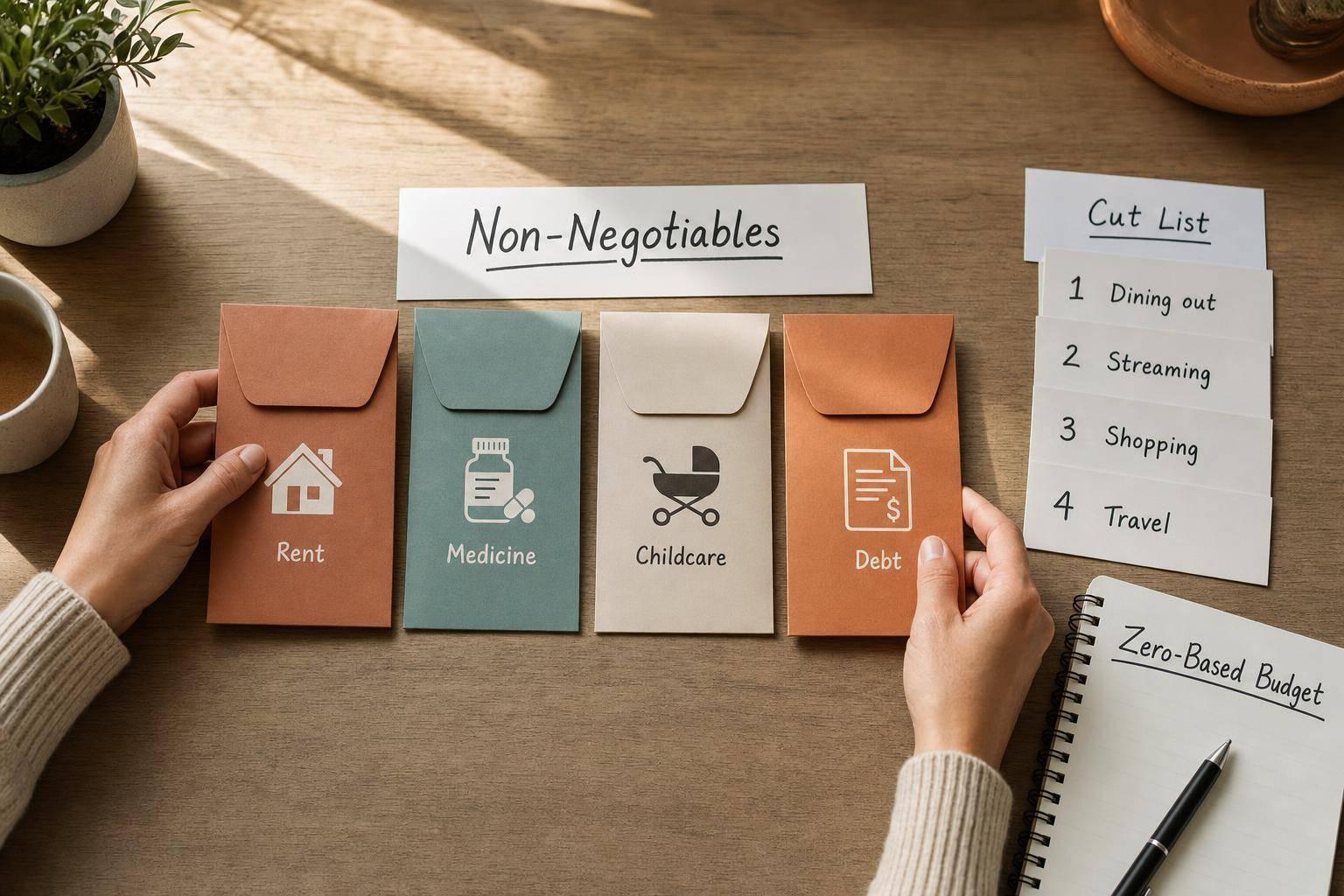
If your budget doesn’t protect rent, medicine, childcare, and minimum debt payments first, it can break the moment income dips.
I’d boil this approach down to four steps: name what I won’t cut, check past spending, give every dollar a job, and decide in advance what gets cut first. Instead of forcing my money into fixed ratios like 50/30/20, I start with the bills and priorities that matter most, then I assign what’s left.
Here’s the whole idea in plain English:
- Non-negotiables come first: housing, utilities, groceries, insurance, transportation, minimum debt payments, and any spending tied closely to my top values
- Values guide the next dollars: things like retirement, an emergency fund, health costs, or family time
- Flexible spending comes last: takeout, hobbies, subscriptions, and extra shopping
- Lean-month planning matters: I use my lowest take-home month from the past 12 months as a stress test
- Weekly check-ins help: even 15–20 minutes a week can catch overspending before it hits rent or groceries
A simple example from the article makes the point fast: on $4,200/month take-home pay, $2,450 goes to core bills first, $950 goes to value-based goals, and the last $800 covers flexible spending. If money gets tight, I cut dining out before I touch medication.
One more thing stands out: fixed-percentage budgets can fail when housing is high. If rent is $1,800 on $3,500 take-home pay, that’s about 51% of income on housing alone. In that case, preset ratios stop matching real life.
Below, I’d focus on how to sort expenses into needs, wants, and value-based priorities, build a zero-based plan, and make a cut list before stress hits.
Define your values and name your non-negotiables
Needs are the basics you need to live and function: housing, utilities, basic groceries, insurance, transportation, and minimum debt payments. Wants are the extras. Values are your personal priorities - the reason behind how you choose to spend. Non-negotiables are the costs you protect no matter what: all of your needs, plus any wants that line up so closely with your top values that you won’t cut them, even during lean months.
List the values that shape how you spend money
Start by picking 3 to 5 core values. Common examples include security, health, family, personal growth, and financial freedom. Then tie each value to a clear spending priority.
If health is on your list, that could mean prescription costs or a gym membership. If family matters most, that might mean family activities or time together that costs money. Start with your top values, then connect each one to the spending it should protect.
Tell apart true essentials from flexible spending
Use this four-question test for each expense to decide whether it belongs in your non-negotiable tier:
- Is it required by law? (taxes, minimum debt payments)
- Is it needed for health? (medication, basic healthcare, insurance)
- Is it required to earn income? (basic internet for remote work, commuting costs)
- Is it tied directly to a top value? (a gym membership when health is your #1 priority)
If an expense passes even one test, put it in your non-negotiable tier.
This is where things can get a little slippery. Wants often sneak into the “needs” bucket - premium cable, name-brand groceries, or an internet package that’s faster than you need for work are common examples. Go through that category with a clear eye. You’re trying to sort what’s fixed from what has room to move.
The next step is matching your real spending to these priorities.
sbb-itb-02fd20a
Review your spending and match it to your priorities
Now that your non-negotiables are clear, tie them to your actual spending. Look back at 1–3 months of bank, card, and cash transactions to see where your money has actually been going.
If your income goes up and down, zoom out and review 6–12 months instead. That gives you a more honest baseline.
Once you have the numbers, add up your fixed expenses and the minimum you need for variable basics like groceries and gas. That number is your bare-minimum monthly total - the floor your budget can’t drop below.
Sort past transactions into needs, wants, and value-based categories
Go through each transaction and place it into one of three buckets: fixed essentials, variable essentials, or discretionary spending. The goal isn’t just to sort expenses. It’s to see whether your spending lines up with what matters most to you.
A simple way to make that connection easier is to compare last month’s spending with the values you listed earlier. Then tag categories with labels like Family, Health, or Future You.
| Expense | Category |
|---|---|
| Rent / mortgage | Fixed Essential |
| Prescription medication | Variable Essential |
| Childcare | Variable Essential |
| Minimum debt payment | Fixed Essential |
| Takeout meals | Discretionary |
| Streaming subscriptions | Discretionary |
That gives you the numbers you need to build a zero-based budget around your priorities.
Use Monefy to track categories and fund priorities first

Once your categories are set, track them the same way each time so your top priorities get funded first. Monefy lets you make custom categories and label them with value tags like Family, Health, or Future You instead of tossing things into a vague bucket like Miscellaneous.
Here’s the working rule: fund non-negotiables first, then assign the rest. Use Monefy’s balance view to check that your essentials are covered before you spend on flexible categories.
Build a zero-based budget starting with your non-negotiables

Values-Based Budget vs. 50/30/20 Rule: A Side-by-Side Breakdown
Once your categories are set, turn them into a zero-based plan. Zero-based budgeting means you assign every dollar before the month starts. That does not mean you plan to spend everything. It means each dollar gets a job, including money for savings and emergency contributions.
Fund essentials first, then assign the rest by priority
Take the categories you tracked and turn them into a monthly plan. Start by giving every dollar a clear purpose, and do it in order.
- Non-negotiables first - rent/mortgage, utilities, insurance, minimum debt payments, basic groceries, and transportation
- Value-based priorities second - retirement contributions, emergency fund, and spending that matters to you, like a family activity fund
- Flexible categories last - dining out, subscriptions, hobbies, and a small buffer for misc. expenses
Here’s how that looks on a $4,200 monthly take-home:
| Category | Item | Amount |
|---|---|---|
| Non-Negotiables | Rent/Mortgage | $1,400 |
| Groceries | $450 | |
| Medication/Healthcare | $150 | |
| Transportation/Gas | $200 | |
| Utilities | $150 | |
| Debt Minimums | $100 | |
| Subtotal | $2,450 | |
| Value-Based Priorities | Retirement Contribution | $450 |
| Emergency Fund | $200 | |
| Family Activities | $300 | |
| Subtotal | $950 | |
| Flexible | Dining Out | $250 |
| Subscriptions | $50 | |
| Clothing | $100 | |
| Buffer/Misc | $400 | |
| Subtotal | $800 | |
| Total Remaining | $0 |
When money gets tight, cut from the flexible group first. Rent stays. Medication stays. The dining-out line is the one that shrinks.
That’s the big reason fixed percentage rules can fall apart when essentials eat up a bigger share of your paycheck.
Compare a percentage-based budget with a values-based zero-based budget
The 50/30/20 rule puts all “needs” into one big bucket and keeps the ratios fixed, no matter what your month looks like. A values-based zero-based budget works differently. It funds your non-negotiables by name, then shifts the rest based on what matters most that month.
| Feature | 50/30/20 Rule | Values-Based Zero-Based Budget |
|---|---|---|
| Non-Negotiables | Grouped into a broad "Needs" bucket | Funded first as individual, justified line items |
| Income Changes | Ratios stay fixed; spending scales with income | Extra income is intentionally assigned to high-value goals |
If your rent alone is $1,800 on a $3,500 take-home, that already eats up 51% of your income. So the 50/30/20 setup gives you less room right out of the gate. A zero-based budget doesn’t start with preset percentages. It starts with what you must cover first, then assigns the rest in order.
After the budget is built, stress-test it against a lean month.
Stress-test your budget and plan cuts before you need them
Now it’s time to pressure-test the line items you just funded. A budget that works in a strong month can fall apart fast in a weak one, so test it before that happens. Start with your lowest monthly take-home income from the past 12 months. Then run your budget against that number.
If the plan only works when income stays above that floor, there’s a gap. And that’s something to fix now, not when money gets tight.
Build a ranked cut list for tight months
Set your cut plan in advance so you’re not making choices in the middle of stress. Review your discretionary spending and rank it from cut first to cut last. For many people, the order looks something like this:
- Unused subscriptions
- Dining out
- Hobby spending
Your baseline budget should fund fixed and variable essentials first.
That ranking becomes your default move in a tight month. No guessing. No last-minute panic.
One simple step that helps a lot: build a small sinking fund for predictable irregular costs, like car registration or holiday gifts. Putting aside a little each month can stop those bills from turning into a mess when they show up.
Use Monefy for weekly check-ins and quick adjustments
A 15- to 20-minute weekly check-in helps you spot problems before they snowball.
During that review, watch for two signs. First, are your "wants" categories getting drained too early? Second, are any essential categories starting to creep past their limits? If a flexible category is running hot, trim it right away instead of waiting until month-end.
Monefy keeps this part simple. Log expenses as they happen during the week, then use your weekly check-in to review category totals and make sure nothing is spilling into protected territory.
See how a stress-adjusted budget compares to your normal plan
The table below shows what changes - and what doesn’t - when income drops or a surprise bill lands. Housing, medication, childcare, and debt minimums stay protected. Flexible spending gets cut back or paused.
| Category | Normal Plan (Comfort) | Stress-Adjusted (Survival) | Action Taken |
|---|---|---|---|
| Housing | Full Payment | Full Payment | Protected |
| Food/Groceries | $600 (Organic/Treats) | $400 (Basic/Bulk) | Reduced |
| Medication | Full Cost | Full Cost | Protected |
| Childcare | Full Cost | Full Cost | Protected |
| Debt Minimums | $300 | $300 | Protected |
| Emergency Fund | 20% Allocation | Paused | Paused; balance kept intact |
| Wants/Dining | $400 | $0 | Paused |
| Subscriptions | $100 | $15 | Paused |
Use this fallback plan any time income drops. Once you’ve set it up, update it as your income changes.
Conclusion: Keep your budget in line with your real priorities
Once your fallback plan is in place, the next step is keeping your budget tied to what matters most to you each month. A values-based budget is deliberate, not restrictive. It gives your money a clear job: fund the things that come first.
Weekly check-ins make it much easier to stay on track, and Monefy helps keep that routine simple. Log spending as it happens, review your totals, and make sure nothing drifts into money you've set aside for your non-negotiables.
This is where it starts to click. You can say yes to the things that matter without that nagging stress of wondering if you can afford them. That's what protecting your non-negotiables actually gives you.
FAQs
How do I choose my non-negotiables?
Review your bank and credit card statements from the past three months and make a list of recurring expenses. Split them into fixed costs - such as rent, utilities, insurance, and minimum debt payments - and variable necessities like groceries and basic transportation.
Use those numbers as your survival baseline. And treat emergency savings and retirement contributions as non-negotiable commitments, right alongside your monthly bills.
What if my income changes every month?
Start with a baseline based on your lowest-earning month from the past year, or go with a conservative figure that’s 20%–30% below your 12-month average. Use that amount to cover your non-negotiables first, like rent, utilities, and debt payments.
To add some stability, pay yourself a fixed monthly amount from a holding account and keep extra income there as a buffer for lean months. When income is up, don’t let spending creep up with it. Put that extra money toward savings instead.
How often should I review my budget?
Review your budget at least once a month to make sure your spending still lines up with your core values and financial goals.
For a lot of people, that monthly review works best when it’s paired with shorter check-ins along the way. A weekly check-in can help you keep flexible spending in line, and daily transaction tracking makes it easier to stay aware of your habits, keep your records accurate, and fix small issues before they turn into bigger ones.